Conference Venue Hire: Keeping Costs Under Control
Getting conference venue hire right is harder than ever if you want predictable tech, seamless hybrid support, and no invoice surprises—especially when time and accountability are non-negotiable.
Key Takeaways
- Demand transparent tech and cost data in every conference venue hire shortlist—this is now table stakes, not a nice-to-have.
- Hybrid event support, clear bandwidth specs, and documented AV inventory will make or break decision speed and risk.
- Insist on itemized cost breakdowns and flexible cancellation—hidden single line pricing is a red flag, not a “bargain.”
- Why “Hybrid‑Ready” and Tech Details Are Now Non‑Negotiable
- Quick Market Snapshot — Demand, Venue Types & Booking Behavior
- Top Planner Pain Points That Kill Shortlists
- The Technical Spec Sheet — exact fields to demand from every venue
- A Planner’s Tech Checklist — Questions to Ask Every Venue
- Staging, Seam & Sightline Practicals
- Pricing Benchmarks & True Costing
- Typical Add‑On Prices to Budget For
- Booking Lead Times, Cancellation & Flexibility — What to Expect in 2026
- How Premium Venues Justify Higher Rates
- Details most venues never publish — request them in your RFP
- FAQ
Why “Hybrid‑Ready” and Tech Details Are Now Non‑Negotiable
The world of conference venue hire has changed. Senior planners now filter venues with a single RFP question: does your documentation prove you’re hybrid-ready and can you guarantee upload speeds, bandwidth, and in-room hardwired access? If not, you are out of consideration—no matter how glamorous your photos are.
After COVID, “hybrid-ready” and detailed tech specs are baseline. If venues don’t immediately publish concrete AV, bandwidth & Networking, and connectivity information for every major space (brand, numbers, in-room positions), trust erodes and the venue is excluded early. If you want to avoid downstream headaches with streaming, platform integration, and attendee device support, ignore venues that rely on vague “high-speed Wi-Fi” promises or do not mention service level agreements (SLAs).
Research confirms this: “Post‑pandemic support for in‑person meetings remains strong; however, hybrid design and digital components are now standard expectations.” (2025 Meetings Industry Forecast).
Quick Market Snapshot — Demand, Venue Types & Booking Behavior (What planners must know)
The global market for conference and corporate event venue hire is accelerating. The events market was USD 736.8 billion in 2021, projected to hit USD 2.5 trillion by 2035. Booking platforms report persistent high demand as digital research becomes universal. Venue types are diversifying from classic hotels and auditoriums to unique and alternative spaces. The share of events in alternative venues rose from 26 percent (2019) to 31 percent (2023).
Lead times are splitting: short for local meetings (1-3 months), still long for large conferences (6-18 months). Planners increasingly search for a conference venue near me that offers inventory transparency, combo spaces, and custom layouts. Demand is highest for venues that can publish full cost, AV, streaming, and wellness data up front (not after your third email).
Top Planner Pain Points That Kill Shortlists (so you don’t repeat vendor mistakes)
Planners drop venues from shortlists for five recurring failings:
- Vague AV inventory—if the spec doesn’t list brands, counts, and diagrams, it’s a time-waster.
- Internet not specified—if upload/download, dedicated/shared and redundancy aren’t published, assume there’s a risk.
- Hidden fees—sudden “service charge,” unexplained AV or technician cost on the final quote. Always ask line by line.
- Floor plans missing or basic—if you can’t download a scaled plan with power and rigging info, expect unpleasant surprises later.
- Unclear cancellation and attrition policies—if these aren’t digital and specific, planners lose trust early.
Backed by data: Planners cite “lack of detailed AV inventory and diagrams” and “unspecified or vague internet capabilities” as top pain points according to research findings.
Don’t forget: slow responses, dated PDFs, and “contact us for details” are deadly for busy planners expecting conference hall rental information at a glance.
The Technical Spec Sheet — exact fields to demand from every venue
Make your RFP template and your shortlisting simpler by demanding these non-negotiable fields for conference venue hire or conference hall rental:
- AV Inventory: All installed and rentable equipment by brand, count, coverage diagram, and locations (audio, video, lighting, playback support, monitor positions).
- Bandwidth & Networking: Explicit upload/download for dedicated vs shared bandwidth (e.g., 100 Mbps symmetrical dedicated), number of hardwired ports per room, locations, redundancy/backup (5G or ISP), Wi-Fi device support per room, and SSID details.
- Staging Specs: Stage platform size(s), modularity, maximum load, ceiling height, rigging point load & placement, and power drop maps.
- Room Details: Name, floor area (m2 or ft2), minimum/maximum ceiling height, pillar/obstruction map, door/load-in width and routes, natural light, and acoustics info.
- Capacities: Maximums for theatre, classroom, cabaret, boardroom, banquet—with staging and catering in place (not empty room maximums).
Venues that list only “Wi-Fi available” or “projector and sound system” without detail are asking for troubleshooting or technical risk mid-event.
A Planner’s Tech Checklist — Questions to Ask Every Venue
Use these checklist questions for every conference room hire for the day, RFP, or site visit:
- What’s the guaranteed upload/download speed, dedicated vs shared, and is redundant internet available?
- Where are all wired network ports in the room? How many concurrent devices are supported on Wi-Fi?
- List all installed microphones, projectors, screens, and control positions with brand/model if possible.
- What in-house technician support is included? What are hourly rates for additional tech labor—minimum callout?
- Are third-party AV or broadcast crews allowed on-site (any restrictions or surcharges)?
- Can we access floor plans with power, rigging, and sightlines indicated?
- How are streaming/hybrid components supported—what’s in place, and what’s not possible?
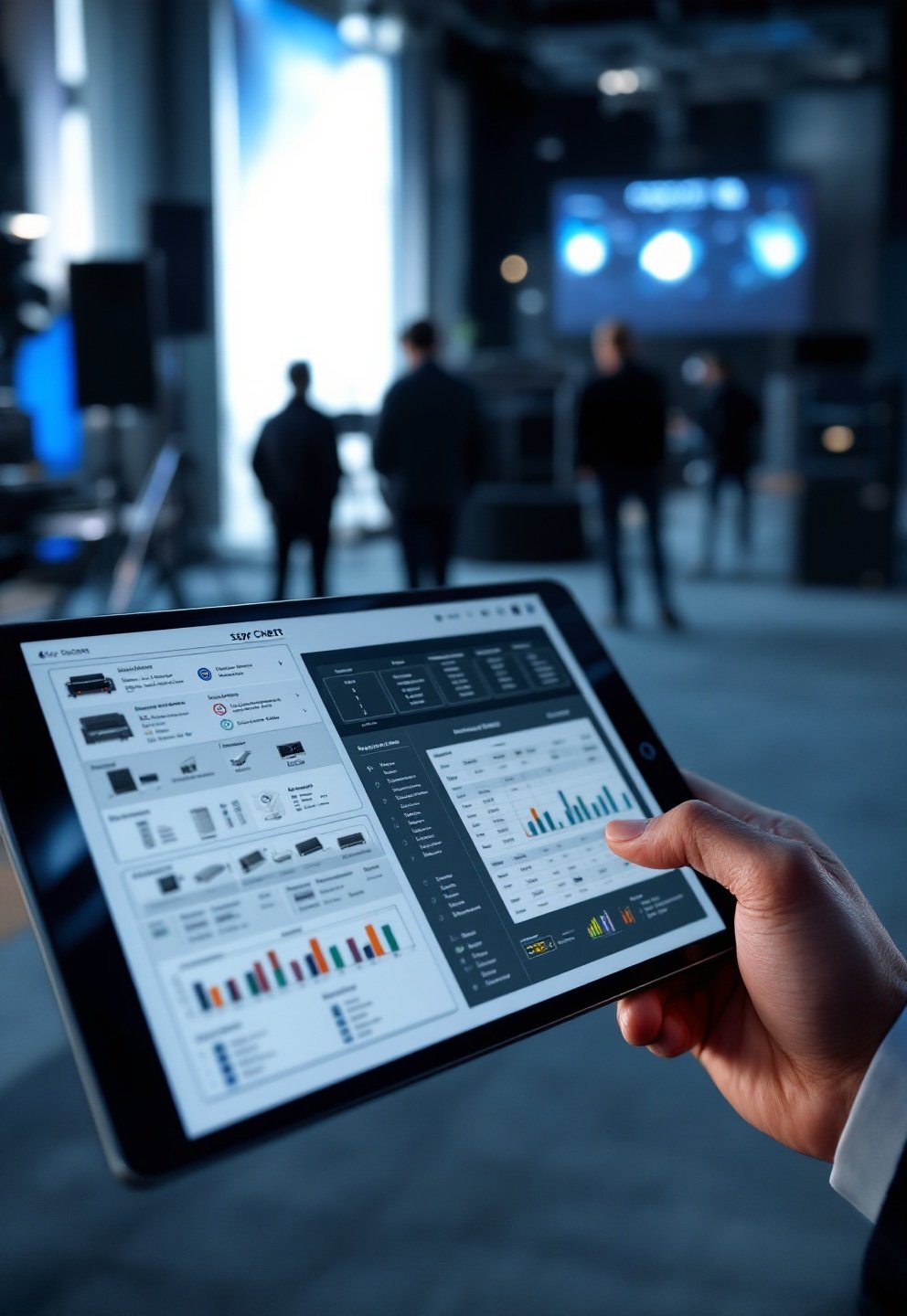
Staging, Seam & Sightline Practicals (dimensions, loads and layouts you must see)
If staging or AV installation is in play, demand these details:
- Stage platform size(s), length, width, and height—plus confirmation of modularity and load rating (e.g., “max 750kg platform”).
- Ceiling height above stage area (if truss, ground support or flown production is needed).
- Load-in routes, door dimensions (double-check for flight cases), proximity of power and rigging points.
- Accessibility—ramps, lifts, ADA compliance, path diagrams for audience and presenters.
- Maximum capacities by setup with installed AV and catering tables in place. Empty room numbers are misleading.
Often-missed but critical: publish sightline diagrams that show pillar, screen, and camera obstruction zones for each seating layout, especially in non-standard or alternative venues. For conference and events venue spaces with quirky architecture, test sightlines with real setups before confirming your booking.
Pricing Benchmarks & True Costing (small rooms vs large venues + add‑ons)
Red-flag any conference venue hire quote that is a single line. Instead, benchmark using these typical 2026 ranges:
| Space/Size | Lower-Cost City (USD/EUR) |
Major Hub (USD/EUR) |
Included in Base |
|---|---|---|---|
| Small meeting room (up to 40 pax) |
200–600/day | 600–1,500/day | Basic AV (screen, projector), Wi-Fi |
| Medium conference (100–300 pax) |
1,500–5,000/day | 2,500–7,500+/day | AV, Wi-Fi, tables/chairs |
| Large plenary (300–1,000+ pax) |
5,000–12,000/day | 7,500–20,000+/day | AV, Wi-Fi, base lighting |
| Delegate day rate | 60–120/person/day | 100–200+/person/day | Room, AV, catering, Wi-Fi |
For small conference venue hire, add-ons and service levels drive variance. Never assume catering, technician time, or all-day internet are included unless stated.
Typical Add‑On Prices to Budget For (AV, streaming, catering, tech support)
Complete your conference room hire for the day quote estimate with these ballpark add-ons:
- Onsite technician: USD/EUR 50–150/hour (min. 2-4 hours per day).
- Catering: Small meetings USD/EUR 20–60 per head (coffee, snacks, light lunch); Larger events USD/EUR 50–150+ per head (buffet, served lunch, premium breaks).
- Streaming production (platform, crew, gear): USD/EUR 3,000–20,000 per day, rising for full hybrid setups and broadcast multipoint.
- Extra AV (cameras, mics): USD/EUR 100–400 per item/day if not included in base.
Demand itemized breakdowns in your quotes. Benchmark against event industry sources and premium catering checklists so you’re not blindsided by hidden extras post-contract.
Booking Lead Times, Cancellation & Flexibility — What to Expect in 2026
Covid shifted lead times for conference hall rental. For small-to-mid meetings, expect lead times of 1–3 months. Large events still book 6–18 months ahead in prime destinations.
Typical cancellation:
- >180 days: minimal penalties or refund
- 90–180 days: partial penalty (25–50 percent of value or deposit lost)
- <90 days: 75–100 percent of contract due
Best-in-class contract terms allow credits or flexible rescheduling with deposits carried into the next booking—confirm this up front. As always, review force majeure clauses for coverage of health, travel, and governmental restrictions.
How Premium Venues Justify Higher Rates (technology, flexibility, service)
Higher rates only make sense where value is clear. Top conference and events venue options can justify their pricing by:
- Offering dedicated symmetrical bandwidth with SLAs, separate networks for production, and on-site IT/AV staff for the entire event.
- Built-in broadcast production, AI-enhanced translation, and automated captions as standard.
- Spaces that reconfigure instantly, integrating indoor-outdoor amenities, natural light, wellness rooms, and ADA accessible layouts.
- Sustainable catering, carbon reporting, and quick-turn digital documentation.
- Fast response norms and dedicated planning support for every contract.
Research shows that premium venues increasingly compete on hybrid technical confidence and contract flexibility, not just luxury finishes (top 2025 event trends) and venue experience reports.
Details most venues never publish — request them in your RFP
Most venues and comparison sites still fail to publish these — request them directly in your RFP:
- Numeric bandwidth and upload speeds (dedicated vs shared) and redundancy details.
- Full AV inventory with brand, quantity, and location diagrams.
- Downloadable technical floor plans with marked power, rigging, sightlines, ADA paths.
- Transparency on accessibility, environmental ventilation, noise treatment, and sustainability practices.
- Clear, itemized pricing breakdowns (room, AV, Wi-Fi, setup, catering, support).
- Contract window details, pandemic/force majeure policies, and privacy/data handling statements—key for corporate buyers.
Venues that publish this level of detail are consistently easier to shortlist and negotiate with.
FAQ
What should always be included in a conference venue hire quote?
Always demand itemized breakdowns: room rental, AV/tech, internet, catering, setup/strike, technician hours, any surcharges or service fees, and cancellation policies. Generic “day rate” quotes usually leave out essential extras.
How do I spot hidden costs in conference hall rental contracts?
Watch for vague line items (“service charge,” “AV package”), ambiguous technician time, unclear overtime rates, and missing exclusions (third-party AV, weekend surcharges). Ask venues to give a detailed schedule of additional/optional charges in writing.
Is hybrid event support standard at most venues now?
For serious venues: yes, but only if specs explicitly list hybrid bandwidth, camera positions, uplink capability, and in-house or approved streaming vendor support. If not visible in documentation, push for details or shortlist elsewhere.
What’s a realistic lead time for booking a large conference and events venue?
For events of 300+ delegates in major cities, aim for 6–18 months in advance. For smaller local meetings, 1–3 months is typical—but flexibility shrinks as prime dates get booked out.
How do premium venues justify much higher prices?
They offer better baseline tech—dedicated internet with SLAs, advanced AV and built-in production capability, modular rooms, transparency, wellness and accessibility detail, flexible contracting, and much higher service levels for planners.